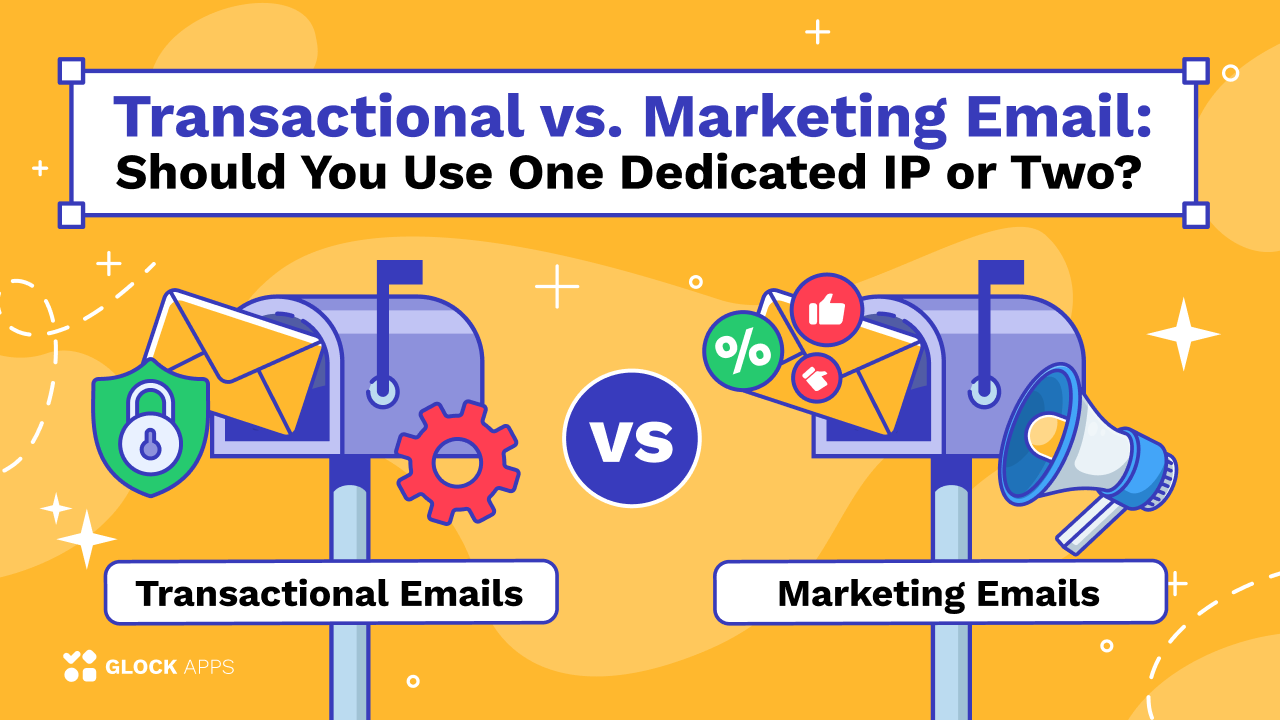
Transactional vs. Marketing Email: Should You Use One Dedicated IP or Two?
Estimated reading time: 8 minutes
Transactional emails and marketing campaigns serve very different purposes, but they often run through the same email infrastructure. That raises an important deliverability question: can transactional and marketing emails share the same dedicated IP address?
Technically, yes. But whether they should depends on your sending volume, reputation, email program, and how critical your transactional messages are.
Key Takeaways
- Transactional and marketing emails can technically use the same dedicated IP.
- Sharing an IP also means sharing its sending reputation.
- Poor marketing performance can potentially affect the delivery of critical transactional emails.
- Separate IP pools provide better reputation isolation for high-volume senders.
- However, splitting traffic across multiple dedicated IPs is not always beneficial if you do not have enough consistent volume to maintain their reputations.
Can Transactional and Marketing Emails Share the Same Dedicated IP?
Yes. There are no requirement or rules that prevents transactional emails and marketing campaigns from being sent through the same dedicated IP address.
For smaller or relatively consistent email programs, this setup may even be practical. You have one IP to configure, warm up, monitor, and maintain.
The problem is that mailbox providers don’t evaluate every email stream in complete isolation. Gmail, for example, evaluates both IP reputation and domain reputation when making delivery decisions.
If both types of mail use the same IP, behavior associated with marketing campaigns can influence the reputation attached to the infrastructure also delivering transactional messages. That is why larger senders often separate the two.
Why Transactional and Marketing Emails Behave Differently
The main reason for separating them is not the content itself. It is the difference in sending patterns, recipient expectations, and risk.
Transactional Emails
Transactional emails are usually triggered by a user action or account event, such as:
- Password resets
- Account verification emails
- Order confirmations
- Payment receipts
- Shipping notifications
- Security alerts
Recipients generally expect these messages. Many are also time-sensitive: a password reset that arrives 30 minutes late may be almost as problematic as one that never arrives.
Google also treats transactional and promotional mail differently in some of its sender requirements. For example, its one-click unsubscribe requirement applies to marketing and promotional messages but excludes transactional messages such as password resets and reservation confirmations.
Marketing Emails
Marketing emails include:
- Newsletters
- Promotional campaigns
- Product announcements
- Sales emails
- Seasonal offers
- Re-engagement campaigns
These sends are normally larger and more campaign-driven. They are also more dependent on list quality, targeting, frequency, and subscriber interest.
A promotional campaign sent to an outdated or poorly segmented list can generate bounces or spam complaints. Gmail specifically recommends keeping user-reported spam rates below 0.1% and avoiding rates of 0.3% or higher, because elevated spam rates can negatively affect inbox delivery.
When transactional and marketing traffic share one IP, these signals are no longer completely separated at the IP level.
The Main Risk: Shared Reputation
A dedicated IP gives one organization control over the reputation associated with that IP. Unlike a shared IP pool, another company’s sending practices cannot directly damage it.
But if you send multiple types of mail through that dedicated IP, those streams still share the same infrastructure reputation.
Imagine that your regular transactional traffic performs well. Then your company launches a large promotional campaign to an older subscriber segment.
The campaign produces:
- More bounces than usual
- A sudden increase in volume
- Spam complaints
- Delivery errors
The effect does not necessarily stop with that campaign.
The same IP is also responsible for sending password resets, payment confirmations, and account alerts.
We recommend using separate dedicated IP pools when senders need to isolate transactional mail from marketing traffic. Its documentation notes that if a marketing campaign generates a high number of complaints, separation can prevent the transactional IP reputation from being affected.
When Using One Dedicated IP Can Make Sense
Separate IPs are useful, but they are not automatically the best option for every sender.
There are several situations where one dedicated IP may be reasonable.
Your Sending Volume Is Limited
Dedicated IP addresses need consistent traffic to build and maintain reputation.
It’s better to use shared IPs for senders without large, regular, predictable sending volumes. It also notes that IP reputation is strongly influenced by historical sending patterns and consistency.
If you split an already modest volume across two dedicated IPs, neither may receive enough regular traffic to establish a strong sending history. In that case, one properly managed IP may make more sense.
Your Marketing Program Is Highly Controlled
Sharing an IP becomes less risky when your marketing operation has:
- Strong permission practices
- Regular list cleaning
- Low bounce rates
- Low complaint rates
- Predictable sending volumes
- Good segmentation
- Consistently engaged recipients
The better controlled the marketing stream is, the less likely it is to introduce sudden negative reputation signals.
Your Transactional Traffic Is Not Business-Critical
For some businesses, transactional emails are helpful but not especially time-sensitive. For others, a delayed OTP, login code, booking confirmation, or payment message immediately affects the customer experience.
The more critical transactional delivery becomes, the stronger the case for isolating it.
When You Should Separate Transactional and Marketing IPs
Using different dedicated IPs or IP pools becomes more valuable as the email program grows.
Consider separating the streams when:
1. You Send Large Marketing Campaigns.
Marketing volume often fluctuates around product launches, promotions, holidays, or sales. Transactional traffic tends to follow customer activity more naturally.
Keeping the streams separate means a sudden marketing volume spike is less likely to disrupt the reputation pattern associated with transactional messages.
2. Transactional Emails Must Arrive Quickly.
Password resets, authentication codes, fraud warnings, and purchase confirmations should not depend on how yesterday’s newsletter performed.
Creating a separate reputation stream reduces that dependency.
3. Your Marketing Lists Carry More Risk.
Even well-managed marketing databases change over time.
Subscribers become inactive, addresses become invalid, and engagement declines. Separating traffic adds another layer of protection for critical messages.
4. You Have Enough Volume to Maintain Multiple IPs.
Adding another dedicated IP is not simply a matter of purchasing one and routing traffic through it. New IP addresses need to establish a sending history and should be warmed gradually.
Mailbox providers may distrust new IPs with little or no sending history and it’s better to gradually increase traffic instead of immediately sending at full volume.
You therefore need enough regular traffic to support both IPs.
One IP vs. Separate IPs
| Setup | Advantages | Potential Drawbacks |
| One dedicated IP | Easier management, consolidated volume, simpler warm-up | Marketing issues can affect transactional reputation |
| Separate dedicated IPs | Reputation isolation, better control by email type, protection for critical mail | Requires more volume, additional warm-up, monitoring, and cost |
| Shared IP pool | Useful for lower or irregular volume, reputation managed by provider | Less control over IP-level reputation |
There is no universally correct configuration. The best choice depends primarily on volume, consistency, risk, and the importance of each email stream.
Don’t Forget Domain Reputation
Separating IP addresses does not mean your work is finished. Deliverability depends on more than IP reputation. Gmail, for example, separately evaluates domain and IP behavior.
For clearer separation, companies often combine dedicated IP pools with different sending subdomains, such as:
- updates.example.com for marketing
- notify.example.com for transactional mail
Each stream should also be properly authenticated with SPF, DKIM, and DMARC.
This makes your email infrastructure easier to monitor while reducing unnecessary overlap between different types of sending.
Monitor Each Email Stream Separately
Once you separate marketing and transactional traffic, monitor them independently instead of looking only at your overall email performance.
Track:
- Inbox placement
- Spam placement
- Bounce rates
- Complaint rates
- Blocklist status
- Authentication
- Delivery errors
- Sudden volume changes
You can use GlockApps Inbox Insight to test where messages sent through your infrastructure land across mailbox providers and review IP-related information, including blocklist status and inbox vs spam placement. This is particularly useful when testing a new IP or comparing the performance of different sending streams.
How to Separate Transactional and Marketing Email Properly
If your volume justifies separate infrastructure, a practical configuration may look like this:
Transactional stream
notify.example.com → Dedicated IP/IP Pool A
Used for account confirmations, password resets, receipts, alerts, and other triggered messages.
Marketing stream
mail.example.com → Dedicated IP/IP Pool B
Used for newsletters, campaigns, promotions, product announcements, and lifecycle marketing.
Then:
- Authenticate each stream properly.
- Warm new dedicated IPs gradually.
- Avoid sudden sending-volume spikes.
- Maintain clean and permission-based marketing lists.
- Monitor bounce and complaint rates.
- Test inbox placement separately for each stream.
- Investigate reputation changes before they begin affecting large portions of your mail.
The objective is not simply to have more IP addresses. It is to create independent, predictable sending streams that are easier to control and troubleshoot.
Conclusion
So, can transactional and marketing emails share the same dedicated IP?
Yes, but sharing an IP also means sharing part of the reputation risk.
For smaller senders with consistent volume and carefully managed marketing lists, using one IP may be perfectly reasonable. Splitting a limited volume across several dedicated IPs can actually make reputation management harder.
For high-volume programs, however, particularly when transactional emails are business-critical, separating marketing and transactional traffic into different dedicated IP pools provides much stronger reputation isolation.
Monitoring is equally important after the initial setup. A healthy transactional IP today can still develop problems later because of configuration changes, reputation issues, or unexpected sending patterns. GlockApps can also run automatic Inbox Insight tests, making it easier to detect changes in transactional email placement over time instead of waiting for customers to report missing messages.
FAQ
For high-volume senders, it often is. Separate IPs or IP pools isolate reputation so that problems with a marketing campaign are less likely to affect transactional email delivery.
Yes. A new dedicated IP has little or no sending history. Volume should be increased gradually so mailbox providers can establish a reputation for the IP.
No. IP reputation is only one part of email deliverability.
It is often a good idea. Separate sending subdomains make the two streams easier to authenticate, monitor, troubleshoot, and manage independently.
Related Posts
Sender reputation is like your credit history, which is evaluated by email receiving servers when they accept your message for Read more
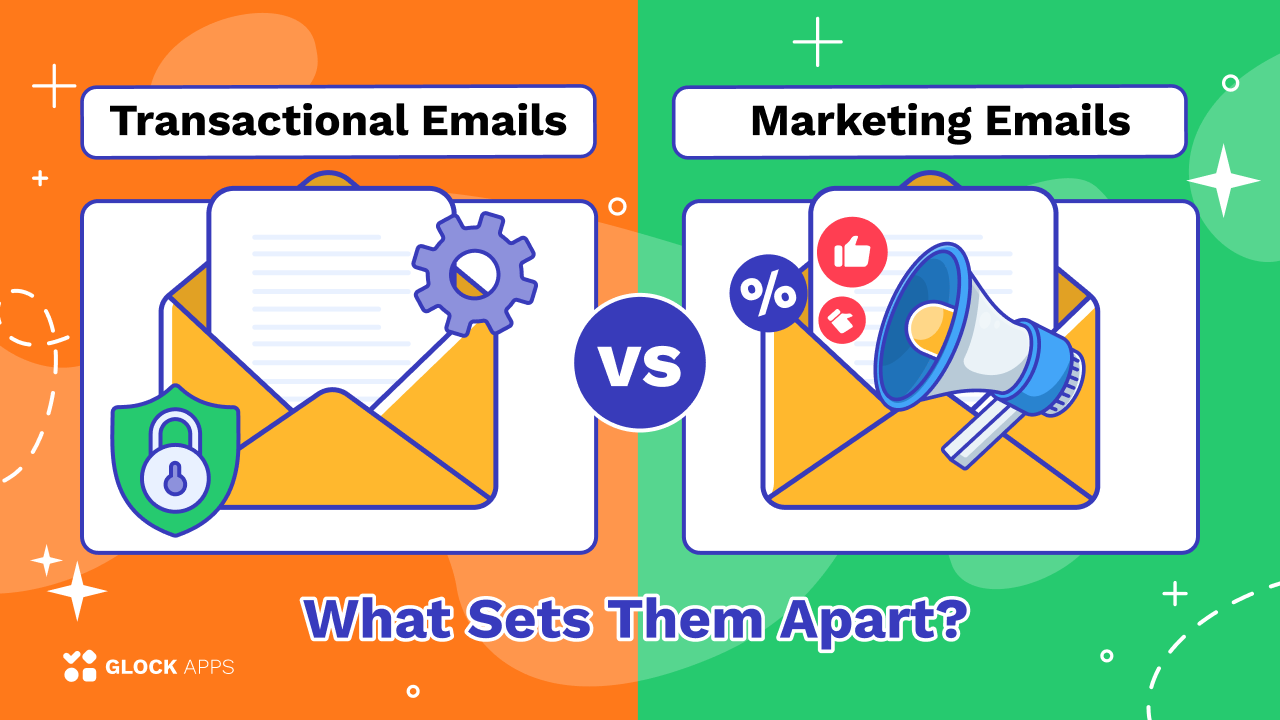
Some emails are designed to promote products and encourage engagement, while others provide important information following a user’s action. These Read more

A transactional email is an automated email message triggered by a specific user behaviour on a website or in an Read more

Every “reset your password,” “your order is confirmed,” and “your package is on the way” message is a transactional email Read more